
From Movie Prop to Production Watch: Murph, Tenet and Dune
More actions
| Production | Screen object | Retail translation | What changed |
|---|---|---|---|
| Interstellar (2014) | Custom Murph prop | Khaki Field Murph 42 mm H70605731 (2019); 38 mm H70405730 (2022) | The retail 42 mm added “Eureka” Morse printing; the 38 mm omitted it |
| Tenet (2020) | BeLOWZERO-based red and blue countdown props | Khaki Navy BeLOWZERO H78505332 / H78505331 | The digital display disappeared; colored seconds-hand tips remained |
| Dune: Part Two (2024) | Asymmetrical Fremen Desert Watch | Ventura Edge H24624330; Ventura XXL Bright H24614330 | The prop's architecture split into digital and analog Ventura interpretations |
The Murph: Morse lettering added for the retail watch
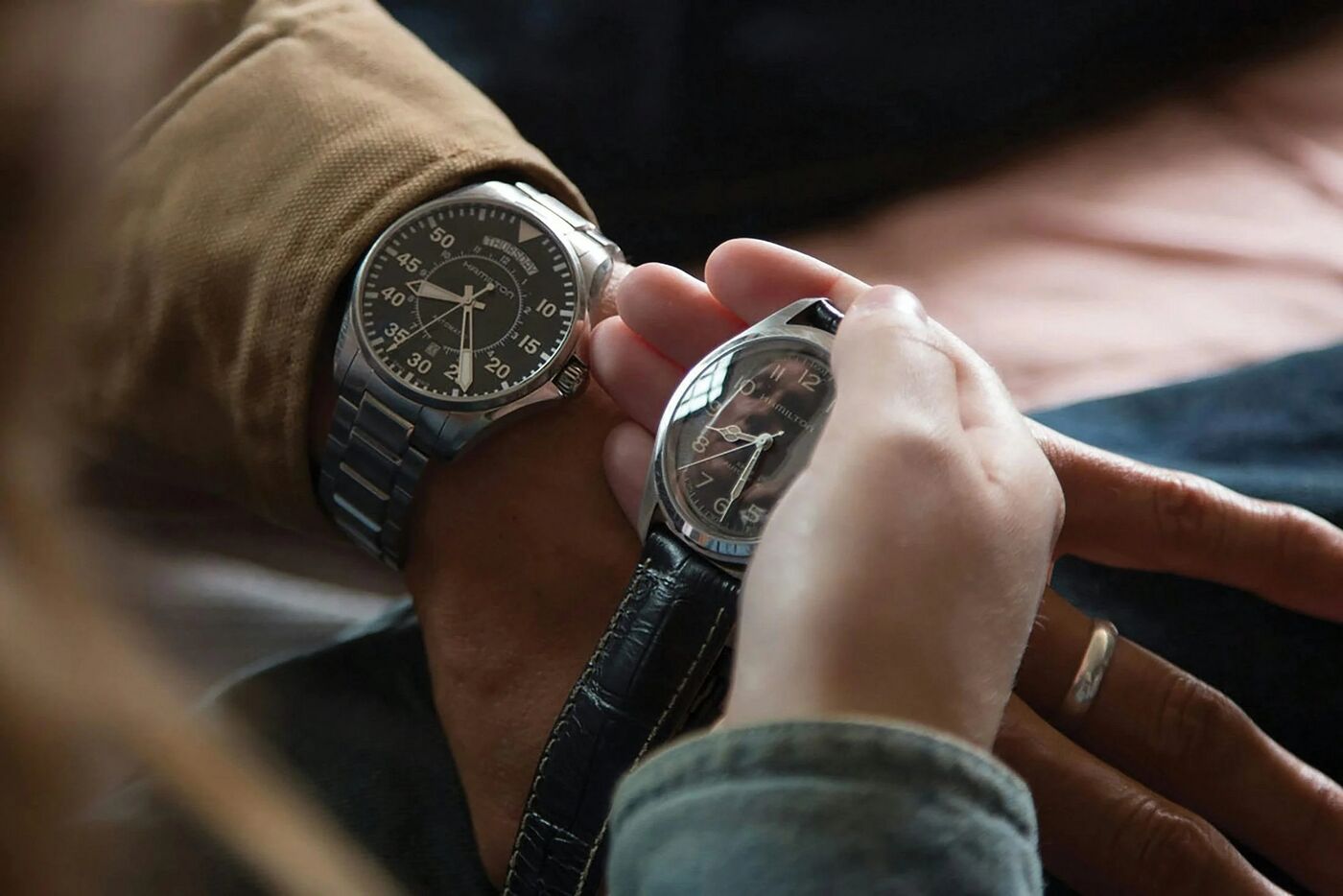
Hamilton created the Hamilton Khaki Field Murph as a custom prop for Interstellar. The field-watch dial reads as conventional; the mechanism driving the seconds hand independently required custom engineering. In the climax, Cooper encodes quantum data through that hand while Murph transcribes the pulses. Production designer Nathan Crowley therefore needed a watch that could behave like an electromechanical display without looking like one.
The 2019 retail H70605731 retained the prop's 42 mm scale, black dial, cathedral handset, and broad polished bezel, but substituted Hamilton's H-10 automatic caliber. It also added a microscopic souvenir the screen watch did not need: “Eureka” printed in Morse code on the seconds hand. Hamilton's first 2,555 examples came in a tesseract-derived box: 2,555 days being seven Earth years, the film's exchange rate for one hour on Miller's planet. Hamilton documents both the prop and that numerical joke in its production history.
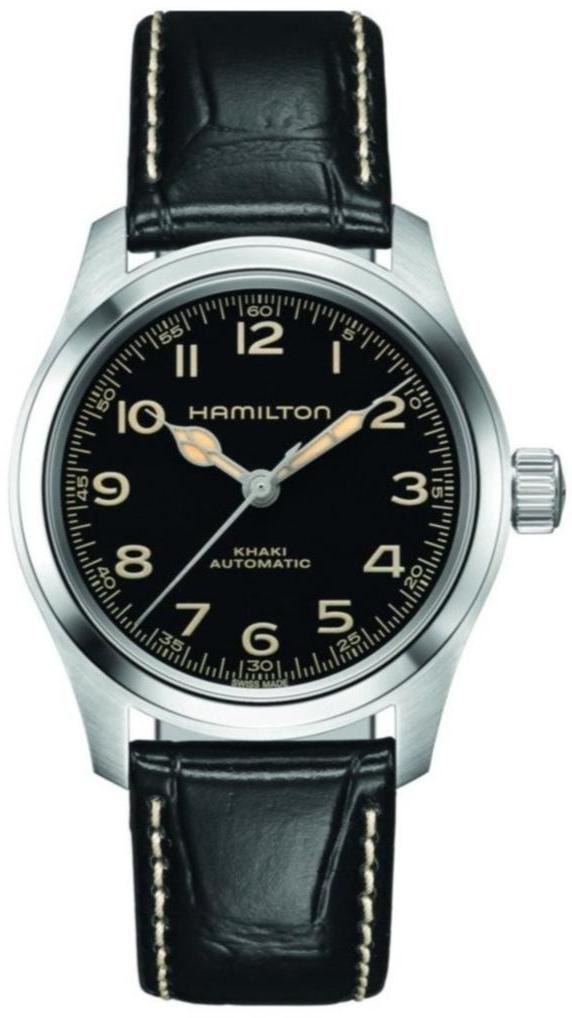
The 38 mm H70405730 followed in 2022. Its proportions are closer to a traditional field watch, but the Morse signature vanished. As Fratello noted at launch, the smaller watch reproduces the design rather than the 42 mm tribute's Easter egg.
The Tenet BeLOWZERO: a functioning display that cannot tell time
The Hamilton Khaki BeLOWZERO already existed when Nathan Crowley selected its 46 mm black case as the chassis for Tenet. Hamilton then spent 18 months engineering a luminous digital countdown into the dial. The finished props retained analog hands, but those hands were fixed. Roughly 40 watches in each color were prepared with different hand positions so the crew could match the apparent time to the countdown without adding the display in post-production.

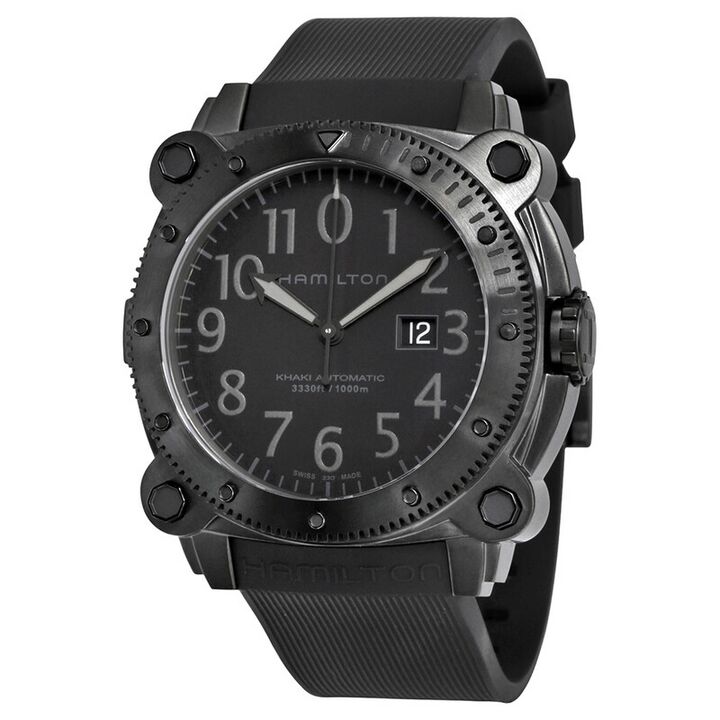
The red display required more current and carried an external battery pack; the blue version concealed its batteries inside the case. Light could bleed through the joint between the central display and minute track. Hodinkee's examination of the film-used props records the fixed hands, power arrangements, and production wear that disappear in publicity photographs.
The retail titanium BeLOWZERO editions used Hamilton's H-10 automatic movement and a conventional dial. Blue- or red-tipped seconds hands and runs of 888 pieces per color referenced the film; neither watch contains a digital screen. Hamilton states that distinction plainly on the product record.
The Desert Watch: one prop, two Ventura descendants
For Dune: Part Two, Hamilton and prop master Doug Harlocker began without a production wristwatch. The Hamilton Dune Desert Watch was drawn as Fremen equipment: an irregular protective shell, exposed relief forms, a cloth fastening, and a thin blue channel recalling the eyes produced by spice exposure.

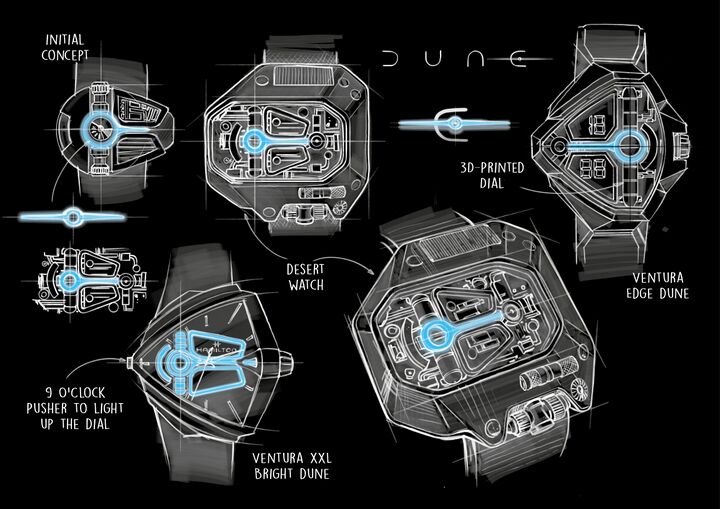
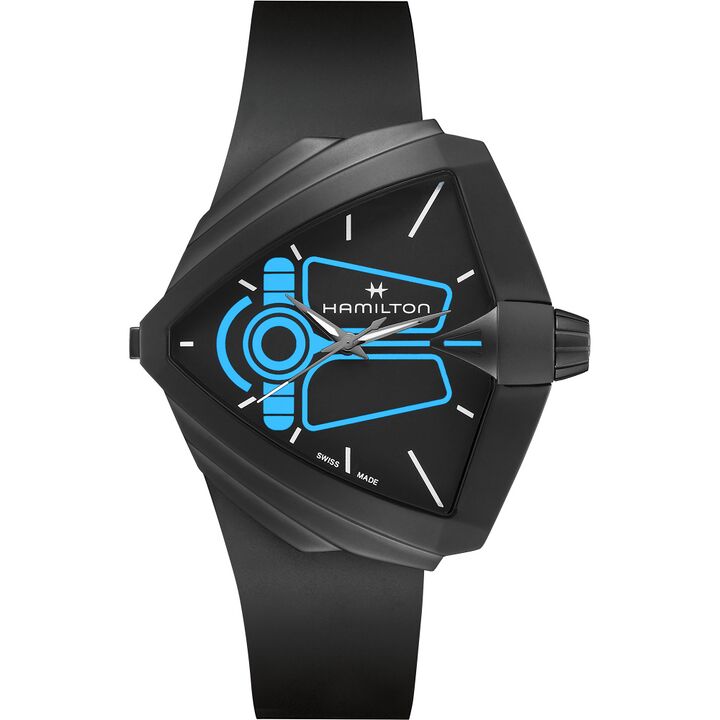
The 51 × 47 mm Hamilton Ventura Edge Dune uses a blue digital display and relief dial inside a black-PVD Ventura case; 2,000 were produced. The 52 × 48 mm Hamilton Ventura XXL Bright Dune is analog, with a pusher at nine o'clock that illuminates a blue circuit-like pattern; its run was 3,000. Hamilton's project page identifies both as designs inspired by the Desert Watch, not reproductions of it.